Richard Dalloway
Mrs DallowayRichard Dalloway, Clarissa Dalloway’s husband, is a conscientious politician whose love for her is genuine but often difficult for him to put into words. His story turns on the distance between feeling and declaration: he crosses London intending to say he loves Clarissa, yet when he reaches her he offers roses instead. She understands the gesture, and his hand in hers becomes an intimate confirmation of a marriage sustained by affection without complete disclosure.
Identity and Background
Richard enters Clarissa’s memories as the fair, rather awkward young man who came to Bourton and had to correct her when she introduced him by the wrong name. Clarissa had called him Wickham; his insistence, “My name is Dalloway!”, became the name by which Sally Seton teased him. The mistaken introduction marks him as an initially uncertain presence in the circle, but Peter Walsh soon recognizes the importance of his arrival: watching Clarissa at dinner, Peter predicts that she will marry Richard, though he does not yet know the young man’s name.
Richard’s public life is presented through his work in the House of Commons and his concern with social abuses. He champions people he considers downtrodden, follows his own instincts, and gathers evidence about alleged misconduct by the London police. He is also angered by the sight of very young children crossing Piccadilly alone and by restrictions placed on costermongers. He attributes these hardships not simply to individual failings but to what he regards as a detestable social system. His political seriousness coexists with a plain, dogged manner that can leave him stiff and inarticulate.
Marriage and Everyday Care
A memory of an injured dog clarifies what Clarissa values in Richard. When the animal is caught in a trap, Clarissa turns faint and Richard takes charge, tending to it and directing her to fetch what is needed. His practical competence and reassuring manner offer a form of steadiness different from the literary and emotional intensity associated with Peter Walsh. The scene suggests that Clarissa’s attachment to Richard rests partly on his ability to act when she is overwhelmed.
Their marriage also contains differences in taste and outlook. Richard takes a solemn view of Shakespeare’s sonnets, arguing that a respectable man should not read them and expressing disapproval of certain relationships. Clarissa finds his position astonishing, yet takes his earnestness for honesty and independence. The contrast does not erase her affection: his convictions, even when they strike her as conventional or absurd, are part of the character she has chosen and learned to accommodate.
A Gift He Cannot Name
While shopping with Hugh Whitbread, Richard remembers a bracelet he gave Clarissa two or three years earlier. She never wore it, and the memory pains him. Now, thinking of Clarissa and the life they share, he looks through a tray of old jewels, lifting a brooch and then a ring, hoping to find a present that would let him approach her with something in his hands. He doubts his taste and ultimately leaves without choosing a jewel.
The search gives his affection a concrete but uncertain form. Richard is eager to cross London to see Clarissa, yet the thought of making his feelings explicit exposes his reserve. He recognizes that people often fail to say what they feel through shyness or inertia, and he nevertheless resolves to do so. Remembering the war and the thousands of men killed, he regards his own life and marriage as a kind of miracle. The intended declaration is not a casual courtesy: it is the culmination of a private journey across the city and a renewed recognition of what Clarissa means to him.
The Visit and Its Unspoken Meaning
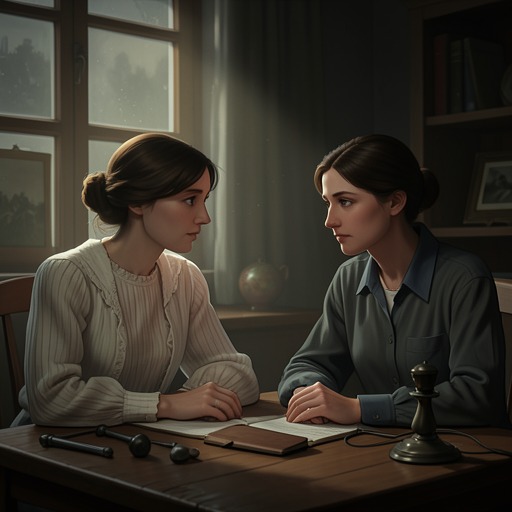
Richard reaches Clarissa’s Westminster home carrying red and white roses. She has been troubled by the day’s social complications, including Lady Millicent Bruton’s lunch invitation to Richard without her, and is preoccupied with her party and her daughter’s closeness to Doris Kilman. Richard’s arrival redirects the moment. He holds out the flowers, but cannot say the words he had rehearsed. Clarissa accepts the roses and understands his feeling without his speaking; she places them in vases on the mantelpiece and asks about the lunch.
The visit does not end in a verbal declaration. Richard holds Clarissa’s hand, and his happiness arises from that contact and from her comprehension of what the flowers convey. The scene preserves both the intimacy and the limits of their communication: he has come intending to speak plainly, but the marriage’s established language of attention and gesture carries the feeling he cannot voice. Clarissa, in turn, receives the gift as a message rather than as a substitute without meaning.
Narrative Role and Significance
Richard’s gestures provide a counterpoint to Peter Walsh’s passionate recollections of Clarissa and to the social performance surrounding her party. His affection is neither theatrical nor effortless. It appears in caretaking, political concern, the search for a present, the walk to Westminster, and the flowers he finally offers. These actions make visible a private attachment that public manners and habitual reserve do not fully express.
The contrast between Richard’s intention and his silence also connects the marriage to the novel’s wider interest in how people know one another. Clarissa understands him without the expected declaration, but that understanding does not abolish the distance between inner feeling and spoken language. Their exchange is therefore both a confirmation of their bond and an instance of its characteristic form: love communicated through a gesture, recognized by the person to whom it is addressed, and left partly unspoken.